

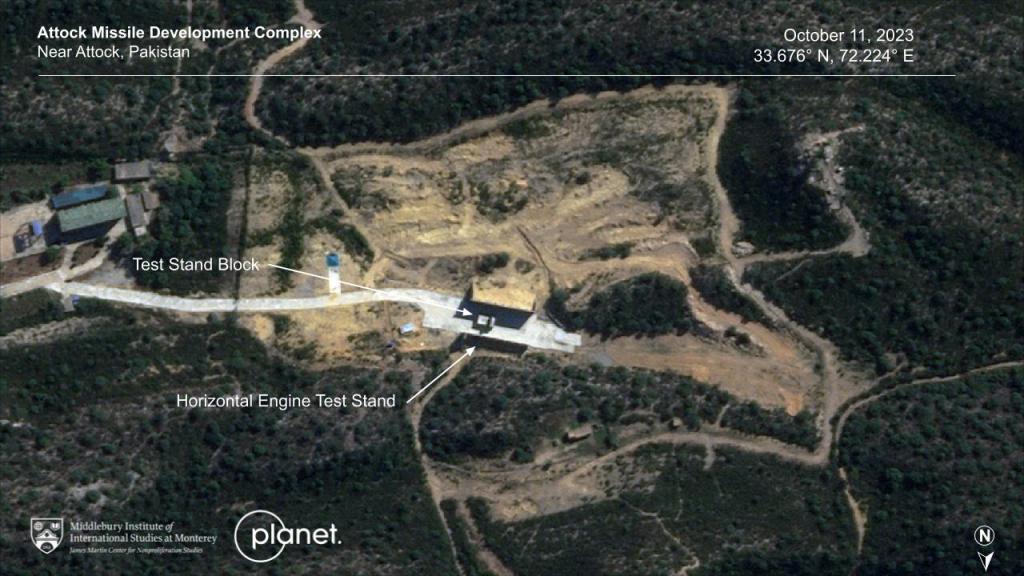
Jonathan Finer, a former Principal Deputy National Security Advisor, dropped a real bombshell back in December when he mentioned during a panel that Pakistan was pursuing an ICBM capability with the United States in mind as a potential target. Pakistan’s interest in a large diameter solid motor missile is entirely unsurprising to me, because I’ve been watching them build a test stand for ICBM-sized motors over the past three years. Sort of hard to hide a facility designed to test missile motors in excess of 2 meters. So that wasn’t the surprising part of Finer’s comments. His comments that emphasized this being an ICBM capability partly aimed at the United States is what drew a lot of raised eyebrows. For example, see Jeffrey’s thread here:
I agree with Jeffrey here, but I don’t want to get too deep into whether or not you find Finer’s specific statements credible. What I want to draw out is the thought, shared by Jeffrey and myself, that Pakistan’s most likely rationale for developing large-diameter missiles, and approach something of a general theory state responses to adversary missile defense capabilities.
It is perhaps unsurprising that as missile technology has proliferated and as states take more of an interest in maintaining large missile arsenals, so too have missile defenses to defeat those capabilities also proliferated. What was previously the exclusive purview of superpowers has now become a common staple of militaries across the world, from Germany, to Israel, to India, to South Korea. And as with all weapons, we have seen adversaries of these countries try different strategies to get around such weapons.
Pakistan is an interesting case study for examining responses to adversary missile defenses, partly because their response has been different than other regional powers. There is considerable variation in the sort of military procurement and nuclear strategies states employ to counter missile defenses. We will explore some variation in these strategies and what factors influence a state’s missile defense defeat strategies.
But first, let’s take a small step back and look at the general situation on the subcontinent. Pakistan’s threat environment has always been mainly shaped by the fact that their main rival, India, is much larger than they are, both in terms of the size of India’s military and economy. India can put more troops into the field and sustain the fight for longer, and unfortunately for Pakistan, the majority of Pakistan’s population centers are on flat land close to the Indian border. This has generated serious concern from Pakistani strategists that a large Indian offensive could simply overwhelm the smaller Pakistani military, which has a much shallower strategic depth. Retreating into more defensible mountain territory would mean effectively surrendering most of its population and economy to Indian occupation.
India is aware of these concerns and there have been some attempt to scope down their military doctrine to avoid this. Under India’s “Cold Start” doctrine, India plans on quickly mobilizing forces after an attack by Pakistan or terrorist groups India considers to be Pakistani proxies and conducting limited, shallow offensives into Pakistani territory. This doctrine theoretically could deter Pakistan from taking low level actions against India and should deterrence fail punish Pakistan and hopefully extract concessions from them related to Indian security concerns.
We do not have the space in these pages for a full discussion of escalation risks on the subcontinent but I would like to point out how shallow the strategic depth in the region actually is. Pakistan’s most populous city, Lahore, begins ten kilometers from the Indian border. An even momentary lapse in the responsiveness of Pakistani forces could risk Indian forces advancing into strategic nodes that Pakistan feels it would have to retake by force, potentially with nuclear weapons if the conventional balance is swinging dramatically in India’s favor. The strategic stability problems are immense.
Pakistan’s solution to this problem has been to adopt a relatively aggressive nuclear weapons posture to deter an Indian conventional action. Unlike India, Pakistan never adopted a no-first use policy, and reserves the option of striking first with nuclear weapons to make sure its military is not overrun by the larger Indian military. India, as the numerically conventionally superior state, does not want to escalate to nuclear use as it knows it can dominate a conventional conflict, and thus has a much more relaxed nuclear posture of secure second strike.
This difference in strategy is then expressed in the missile development priorities of both states. Pakistan prioritizes speed and striking Indian military forces in the field. As such much of their force is made up of small, solid-fueled ballistic missiles, supported by larger medium-range missiles for strategic targets. Pakistan has developed and deployed tactical nuclear missiles as small as the Nasr, which is effectively a rocket artillery system with a range of 70 km, and is placed in known garrisons less than 70 km from the Indian border.
India on the other hand has a force that increasingly deemphasizes small nuclear weapons. Instead, much of India’s missile procurement over the past decade has been focused on building quite a lot of Brahmos supersonic cruise missiles, which are reported to be conventional only. This is combined with the continued development of more advanced conventional delivery systems, like the new BM-04 SRBM, which India very nonchalantly unveiled a couple months ago. These development priorities make a lot of sense for India, as they have the conventional upper hand. There’s no point in developing a war plan that emphasizes battlefield nuclear weapons use when you can win the conventional fight. And if things do escalate to the strategic level, that’s when you roll out the Agni series of IRBMs and ICBMs.
In these cases, and in all cases, we see states prioritizing nuclear delivery system development based on how they envision those nuclear weapons fitting in with their conventional forces, threat environment, and strategic goals. Recently however, we’ve seen the emergence of one technology shake up the formula: missile defenses. Both nuclear states and states that rely on conventional missiles as their primary deterrence force (i.e. Iran) have to now think about the fact that adversaries can deploy dense and overlapping missile defense networks to either outright defeat or limit the utility of their attacks. States appear to have taken different strategies for coping with this issue, which can be oversimplified into two broad camps: quality and quantity.
A strategy of quality emphasizes building large, technically complex missiles capable of delivery multiple missiles and decoys to maximize the ability of a warhead to breach the enemy’s missile defense network. Pakistan’s interest in large diameter missiles is likely a symptom of their desire for such weapons in order to penetrate India’s growing missile defense capabilities. Pakistan has been mentioning this in some form for quite some time. For example, when Pakistan tested the Abadeel MIRVed missile for the first time in 2017, the Pakistani military explicitly said it was to defeat Indian missile defenses.
There is a second solution to missile defenses, one that appears to be more appealing to states like Iran and North Korea: quantity. This strategy posits that the best way to defeat missile defense is to simply build more missiles than the enemy can interceptors. This is a system that sort of works for Iran. Iranian missile strikes did overwhelm Israeli defenses in November, but its unclear from public sourcing if this was due to the maneuverability of Iranian missiles or an Israeli decision to conserve interceptors for another day. Whatever the reason, the end result is the same, and shows the promise of quantity over quality. North Korea clearly has a similar strategy, as evidenced by their rapid production of short-range ballistic missile launchers. Last year Kim Jong Un presided over a ceremony turning over 250 launchers over to the military, all built within a very short amount of time. All of these weapons are nuclear capable, although it’s unclear at what rate the North Koreans can produce fissile material for them.
What determines which strategy and which development priorities are taking place? I’d call out three big ones: posture, distance, and export controls.
We’ve already covered posture a little bit when we discussed the difference between India and Pakistan’s approach to nuclear weapons. Due to Pakistan’s insecurity over their security situation, they have adopted an aggressive nuclear posture that envisions utilizing small nuclear weapons to destroy Indian forces in the field or larger Indian targets at higher levels of escalation. Because of this Pakistan must be able to credibly destroy a large array of targets that would significantly degrade India’s warfighting capabilities. It is partly a deterrence by denial strategy, and this naturally demands a higher damage threshold.
Contrast this to India, a state that has adopted a deterrence by punishment secure second strike doctrine, where the damage threshold is getting a lower number of weapons through to strategic targets. If you only need to credibly threaten the destruction of one or two major Pakistani or Chinese cities to ensure nuclear deterrence, you are much less worried about your missile defense penetration rates at the margin. If you launch 50 weapons and five get through you’ve still hit your damage threshold.
But for states like Pakistan or North Korea that have counterforce first-strike doctrines, even a limited missile defense shield that can degrade the effectiveness of your strikes is a major problem because of the quantity of targets. Take North Korea, for example. South Korea and the United States deploy a robust networked multi-layered missile defense shield that can degrade the effectiveness of North Korea’s missile strikes if not negate them entirely. This is a major problem for the North Koreans, as they need to destroy the United States’ and Republic of Korea’s warfighting capabilities to ensure the survival of their government.
The next two factors, distance and export controls, are somewhat interrelated. Making a short-range ballistic missile is much easier than making an ICBM. As you scale up, you’re making larger and larger engines, which become exponentially more complicated to make, especially in the case of liquid-fueled missiles. For example, there’s a 30-year gap between North Korea’s first launch of a short-range missile, a Scud they had imported from Egypt, and the launch of their first real military ICBM (don’t @ me about Taepodong). North Korea didn’t just build a Scud-sized ICBM because you cannot simply scale a rocket engine up by 200% and expect it to work the same way. It won’t. The RD-250 engines North Korea currently uses in their ICBMs are much, much more complicated than a simple Scud engine.
Then there’s guidance. You can get away in short range missiles with a pretty rudimentary strap-down guidance system because you’re not flying as high or as fast as an ICBM (which produces unique stresses on your missile and warhead that degrade accuracy), and most importantly, you’re not flying as far. Over time errors within the missile’s guidance system compound and your missile begins to fly off course. This means for an ICBM, you need a much bigger and more complicated guidance system to make sure you actually hit the target, and these guidance systems are very difficult to make.
What this means is that if you want make an accurate long range missile, you need some pretty high tech manufacturing capabilities, and if you don’t have that, the ability to import pretty specialized parts form abroad. Pakistan has this because of their extremely close relationship with China and until recently it has evaded the worst of American sanctions on missile technology. This, theoretically, makes them much more able to pursue something like a large missile with advanced MIRV technology.
If you’re adversary’s strategic sites are much farther away, you need a bigger missile. The Republic of Korea’s strategic sites are only 300-500 km away from North Korean launch sites. This means North Korea can target these facilities for much cheaper than Pakistan can target Indian strategic nuclear sites, many of which are on the other side of India. Its a delta of 300 km for North Korea and 2,000 km for Pakistan. Its likely more cost effective for North Korea to simply build hundreds of missiles given range to target.
Why does all this matter? Well for one it matters for our calculations on when to apply sanctions and how those sanctions may affect a state’s missile procurement policies. I have serious doubts that American sanctions on Pakistan’s missile program will significantly degrade the capabilities of the Pakistani program, but if it does, Pakistan could fall back on smaller cheaper missiles to bolster their deterrence.
It also allows us to predict to some extent future procurement choices in other states. Russia is an interesting example of this. Russia is somewhat resource constrained as their economy slows and their ability to maintain a robust conventional military force continues to degrade. Russia has likely made a trade-off calculus at some level on what sort of system would be most effective against NATO’s air defenses. NATO’s missile defenses will be effective against many of Russia’s shorter range systems. To overwhelm NATO Russia would have to produce a staggering number of Iskander Complex batteries, and while Russia has been building up their numbers, they are continually expending more than they can produce in Ukraine.
This is likely part of why Oreshnik has arrived on the scene. Oreshnik is a much more problematic missile defense target than Iskander, and has a higher chance of penetrating. This is effectively an endorsement of the quality doctrine in light of Russian resource constraints.
As missiles continue to proliferate, the tradeoffs between missile defense defeat strategies should be something we have on our minds. Growing missile powers just arriving on the scene will have to be thinking about the same trade-offs, especially as the United States’ missile defense capability show no sign of slowing down.


 hors d'oeuvres of Battle
Leave a comment