


Christmas has come early, the DoD has finally dropped this year’s China Military Power Report. Nothing in this year’s report was all that surprising, but it did reveal some interesting points about how the DoD is counting things up and where we can expect to see China deterrent go in the future. I have some thoughts about the missile counting and some interesting doctrinal stuff you can pull out of this year’s document.
First, the big stuff. In the interest of ensuring that this blog post does not become ten pages, we’re going to breeze through a lot of this. Andrew Erickson already has a very good all-rounder up on WOTR and I’d go read that for a more general overview of the report. Nothing about the total nuclear force structure is all that surprising. It’s mostly what the DoD has been warning about for years: shift to LOW, investment in SSA for early warning, and going full steam ahead on warhead production. China’s stockpile now includes over 600 warheads, and the DoD repeated its claim that China will have 1,000 warheads by 2030. The estimate that China could have 1,500 by 2035 has been dropped, which I’m not shocked about given that it was effectively and extrapolated trendline estimate that got misreported in the media ecosystem. The general direction and trend of the nuclear force has not changed and will likely not change. Indeed, the real surprise would be if we saw a radical shift in any of this language.
Want to take a moment to talk about something that’s not a new emphasis in this year’s report, but is going to be a growing focus for PLA watchers and has some interesting new data points: counterspace and early warning. Before the current build-up China’s basing for its ICBM force had serious survivability problems, and some of those problems were not just due to lack of mobility. There existed a serious window of vulnerability as the vast majority of the Chinese nuclear stockpile was centrally stored in Baoji, sometimes hundreds of miles away from the missile bases. This meant that if China wanted to move from peacetime footing to war footing, it would have to alert its nuclear stockpile units, pull the warheads out, put them on trucks, drive them down to the rail transfer point, train them out to the missile units (which at this point are dispersed around China), take them off the train, put them on a different truck, and finally drive the truck out to the missile unit hiding in a tunnel somewhere. All of this is costly and immensely time consuming. I’d estimate that it would take China at least a week to actually get their entire nuclear force structure up and running under the old system. It is a testament to how seriously the CCP took party control over the arsenal given the immense vulnerabilities this system introduced. The United States could have significantly disrupted the readiness of the vast majority of the Chinese nuclear stockpile with missile strikes on the trains and supporting facilities moving the warheads around.
China’s solution to this problem appears to be twofold: first, it has shifted from a low readiness posture to one where a sizable portion of their nuclear force is on a much higher level of alert. This includes not only their silo force, which is going to number around ~370 launchers when everything is done, but also a portion of their mobile nuclear force on rotating alerts. This is not only reported in the CMPR, but you can see evidence at all of the silo fields, with the construction of sizable underground facilities for the storage of nuclear warheads. This is combined with renewed investment in early warning capabilities – CASI has been doing some great work writing on this topic, a topic I made a very modest contribution to earlier this year. A robust early warning capability would allow China to respond to adversary strikes before incoming missiles impacted their targets, and according to the CMPR, they’ve started actually practicing it:
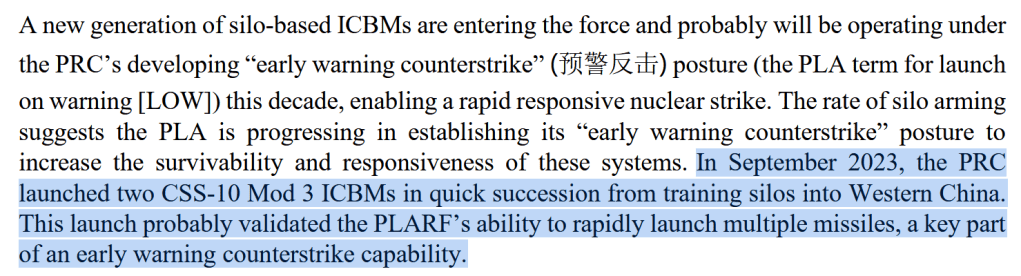
The fact that this capability is included in the LOW section would suggest that the IC is interpreting this event to be a practice drill specifically for a LOW scenario, in which you try to get as many missiles off the ground before you get hit. There’s no way to know specifically what the practice launch was testing, but I suspect they likely launched from the practice silos at Jilantai, which would indicate that its not a missile test, but a concepts of operations test. The PLARF is likely trying to test and validate both their command and control structure and hardware to ensure it will work under stress. I’d also be curious if this test or future tests are also testing missile launch timing to avoid fratricide problems. If you’ve got 120 silos that are all going to same direction you’re going to have to successfully deconflict their trajectories, possibly even on the fly. Then there are additional problems with making sure your nukes don’t nuke your own incoming warheads. This is a really difficult problem the PLA has never had to deal with before, and now does under the new counterforce mission.
Counterspace is the second way China is adding to the survivability of their platforms. China has invested heavily in both kinetic ASAT weapons and laser dazzlers capable of blinding satellites. This means the United States is going to have a lot of difficulty actually tracking the location of mobile Chinese assets, and if China decides to start dazzling satellites during a crisis, the status and readiness of Chinese warhead units and other units critical to strategic deterrence. If we can’t see it, we can’t land a cruise missile on top of it. The worrying aspect of this development is the potential use of laser dazzlers to try to hide readiness. If the United States cannot see the readiness of nuclear units it may have difficulty gauging the response it will get from kinetic strikes as we’d have less information on how seriously China is taking a crisis. One very unrated way that national technical means have revolutionized deterrence is that it allows for some very specific signaling methods to communicate intent. To give you an idea of how specific this can get, I once attended a talk by a USAF general who had been a bomber pilot during the Cold War. He had written a disparaging message on the ground next to his B-52 directed at the Soviets sometime in the 1980s – if I recall correctly, it was something like “Merry Christmas Assholes” or something similar. Apparently the Soviets had been quite cross about this and had asked the Pentagon about it when they got their imagery satellite footage the next month. The pilot was reprimanded.
Regular satellite imaging denial during a crisis disrupts this entire mechanism. States can signal resolve and intent by posturing with specific forces. This is why the United States flies B-52s off the coast of North Korea during crises. But if you can’t see the readiness of nuclear forces, you cannot judge the resolve of the adversary. This is a concerning development and I hope at some point the United States and China can place guardrails on this activity. At least don’t make it a regular occurrence!
Now, the missile counts. The noble and gallant folks over at OSD-P have given me specifically a Christmas gift by actually spelling out which platforms are being counted in the launcher and missile counts of the PLARF. Among other things this confirmed something that’s been bugging me and I’ve complained about on Twitter before, whether they’re counting the DF-16 as an SRBM or an MRBM. Turns out it looks like both. I like to imagine they included that part just for me. I’ve compared those numbers to my own numbers I published last year, and it looks like I was broadly correct on the ICBM and IRBM numbers. I said 507 launchers including training silos, CMPR says 500. I said 252 IRBM launchers, CMPR says 250. I’d say that’s pretty good for a master’s student making 15 bucks an hour at the time if I’m allowed a moment to toot my own horn.
My numbers break down a little when we get to the SRBM and MRBM numbers, but that’s unsurprising for two reasons. First there’s been a massive amount of modernization in these categories with the retirement of older systems and the introduction of new ones. That means there are a lot of legacy systems floating around, and if CMPR is counting stuff in stockpile (not clear on that) then you’d get some higher numbers. The second reason is that its really difficult to get a good picture of the precise breakdown of launchers per brigade at the level of SRBM and MRBM. For ICBMs counting launchers is really easy because there are no reloads. If an ICBM unit has twelve really big garages, you can very justifiably conclude that this unit has 12 ICBM launchers. Not so for SRBMs and MRBMs. A single launcher is going to be accompanied by a reloader vehicle that can crane new missiles into the launcher and more vehicles carrying the reload missiles. This means that for every launcher, there’s going to be an additional 3-4 heavy vehicles accompanying it. This makes estimating the actual breakdown and ratio of launchers to other heavy vehicles really difficult. I estimated in the ORBAT 27-36 launchers per brigade. According to the CMPR some of these brigades could have up to 48 launchers per brigade. If you take my brigade numbers and add more launchers you can definitely get around to the number of launchers specified in the CMPR, but it’s not as simple as that as the PLARF has also been adding some new brigades to the SRBM/MRBM force, and I haven’t had time to run down what those brigades are equipped with. The bottom line here is that the CMPR’s launcher numbers for SRBM and MRBM are entirely believable to me given what we don’t know in open source and what could be happening.
I have attached a complete breakdown below, inserting my launcher counts (some of my launcher counts have not been updated since last year) into each system and seeing if it all adds up to what the CMPR specifies.
| Class | System | Launchers | Class Launchers | Missiles |
| ICBM | CSS-3 (DF-4) | 0 (training platform, possibly in stockpile) | My estimate: 482 not counting training silos. With training silos, ~500. CMPR estimate: 500 | CMPR estimate: 400 |
| CSS-4 Mod 1 (DF-5A) | 6 | |||
| CSS-4 Mod 2 (DF-5B) | 12 | |||
| CSS-4 Mod 3 (DF-5C) | ~30 | |||
| CSS-10 Mod 1 (DF-31) | 0 (stockpile?) | |||
| CSS-10 Mod 2 (DF-31A) | 72 (counts both DF-31A and AG) | |||
| CSS-10 Mod 3 (DF-31AG? B?) | 0-72 (if AG) | |||
| CSS-20 (DF-41) | ~48 | |||
| Other | ? | |||
| Silo | 320 | |||
| IRBM | CSS-18 Mod 1 (DF-26A?) | Launcher is Mod agnostic | My estimate: 252 CMPR estimate: 250 | CMPR estimate: 500 |
| CSS-18 Mod 2 (DF-26B?) | Launcher is Mod agnostic | |||
| CSS-18 Mod 3 (DF-26C?) | Launcher is Mod agnostic | |||
| MRBM | CSS-5 Mod 2 (DF-21A) | 12? | My estimate: 252 CMPR estimate: 300 (likely counting DF-16 launchers in both SRBM and MRBM totals) Possibly counting DF-21A and DF-21 launchers in stockpile (I’m likely missing a DF-17 brigade) | CMPR estimate: 1,300 |
| CSS-5 Mod 4A (DF-21D) | Launcher is likely Mod agnostic for DF-21D and DF-21E, total 24 | |||
| CSS-5 Mod 5A (DF-21E Subtype?) | Launcher is likely Mod agnostic for DF-21D and DF-21E, total 24 | |||
| CSS-5 Mod 5B (DF-21E Subtype?) | Launcher is likely Mod agnostic for DF-21D and DF-21E, total 24 | |||
| CSS-11 Mod 2 (DF-16A) | 36 per brigade, 72+ across DF-16 | |||
| CSS-11 Mod 3 (DF-16B) | 36 per brigade, 72+ across DF-16 | |||
| CSS-22 (DF-17) | 36 per brigade, 144+ | |||
| SRBM | CSS-6 Mod 3 (DF-15B) | 36 per brigade, 72+ | My estimate: 216 CMPR estimate: 300 (likely counting DF-16 launchers in both SRBM and MRBM totals) Possibly counting old SRBMs in stockpile | CMPR estimate: 900 |
| CSS-7 Mod 1 (DF-11A) | 36 per brigade, 72+ | |||
| CSS-7 Mod 2 (DF-11AZT(G)?) | 36 per brigade, 72+ | |||
| CSS-11 Mod 1 (DF-16) | 36 per brigade, 72+ across DF-16 | |||
| GLCM | CJ-10 (DF-10) | 36 | My estimate: 108 CMPR estimate: 150 (I’m likely missing a brigade here) | CMPR estimate: 400 |
| CJ-10A (DF-10A) | 36 | |||
| CH-SSC-13 (DF-100) | 36 |
Of these developments I think the biggest in terms of what it tells us about China’s evolving doctrine is shaping up to be is the expansion in DF-5 silos. The DF-5 is one of China’s oldest ICBMs, a massive liquid-fueled ICBM capable of carrying heavy payloads. Before the silos were found, there was a great degree of speculation from Chinese nuclear scholars that the DF-5 would be retired as it was old and did not fit within the mid-2010s conception of what Chinese nuclear doctrine would be. According to these scholars, The whole point of mobility, which China was investing heavily in at the time with the DF-31 series, was to ensure that China would maintain a small nuclear arsenal that was survivable. But China is actually more than doubling the number of DF-5 silos – which even back in the 1980s China knew wasn’t survivable. The CMPR has this to say about the growing diversity of the nuclear force:
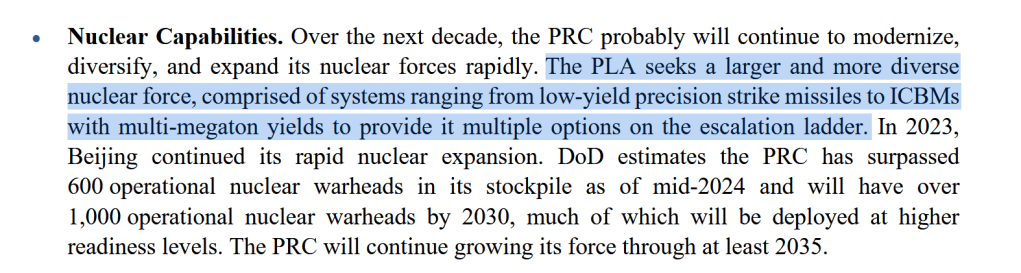
I think this paragraph and the change in DF-5 launcher numbers is a perfect example of how many of the terms we use to describe the Chinese nuclear doctrine don’t really apply anymore. Terms like “minimum deterrence” or “minimum means of reprisal” or even “medium deterrence” don’t really work. At the time in which such words were applicable, we were discussing a China that maintained a small arsenal of nuclear weapons that was interested in mainly executing a single mission – a massive retaliation on enemy value targets after China had absorbed a nuclear strike. There were exceptions to this for sure, but that was the core mission, and that mission was encapsulated by phrases like “minimum means of reprisal.”
It’s not that countervalue isn’t the mission anymore – countervalue is after all the DF-5’s bread and butter – its that its not the only mission. China’s nuclear forces and more broadly the PLARF aren’t a hammer anymore. They’re a toolbox. China is investing in more DF-5 and low yield weapons along with conventional-nuclear integration systems like the DF-26. The point of the arsenal now is to give Xi a set of options for every scenario. They seek to deter at every level of conflict, not simply deterring a major conflict, and are bolstering their capability at all those levels. This is why I raise my eyebrows every time I attempt to see people fit Chinese nuclear forces into the same existing posture frameworks we’ve been dealing with for years, like argue that China still maintains “minimum deterrence.” Their force structure cannot fit inside that box.
Lastly, a short note on the silos. The CMPR has an interesting two-page appendix on PRC corruption, that includes the highlighted sentence:

Back in April I pointed out to Jeffrey that there’s been some very strange activity at Yumen silo field in which a bus pulls up, sets up a red tent over the silo for a couple days, and then leaves. Hard to tell what portion of the field they’ve been doing this for but it seems like most of them are getting this treatment. I suspect that this may be the repair activity that the CMPR is discussing, but I do not know what specifically is being repaired. Yumen has always been odd, especially with the windfarm that overlaps with the silo field.
Those are all the thoughts that are fit to print – I have more but I’m hoping to tackle some other sections of the CMPR a couple upcoming OSINT stories I’m working on. Stay tuned for those.


 hors d'oeuvres of Battle
Leave a comment