

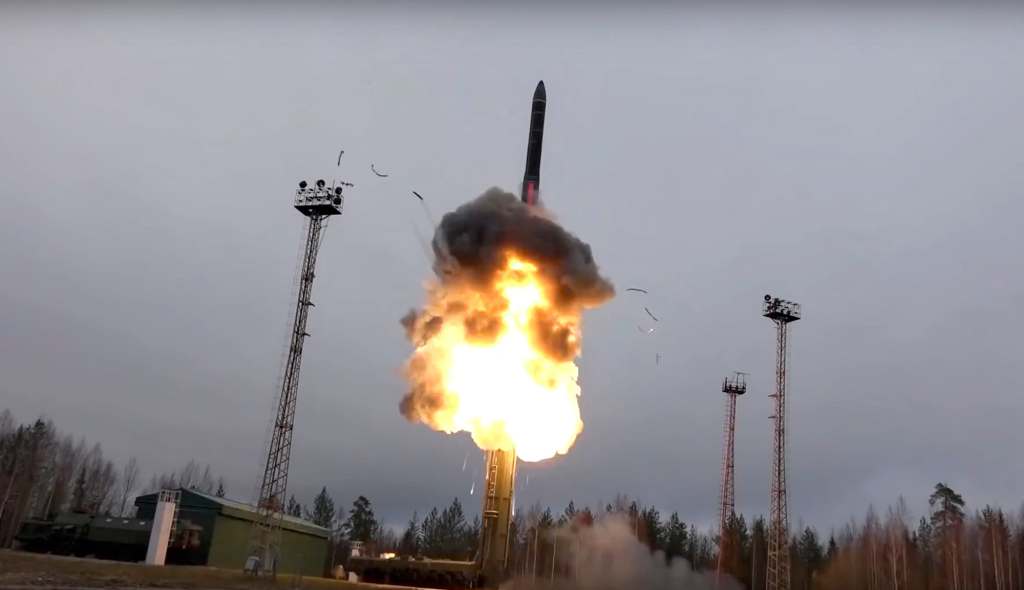
Now that Trump has been reelected and the situation on the frontline seems bleak for Ukraine, the conversation has turned to the possibility that Ukraine could somehow extract itself from its current situation by pulling a nuclear Hail Mary. Everyone – from, apparently, anonymous government officials demonstrating their ignorance by suggesting the US could “return” nukes to Ukraine taken out in 1996, to Slavoj Zizek, are weighing in on this topic.
While Ukraine suddenly becoming a nuclear power is amusing to contemplate, its vanishingly unlikely. Some have suggested that Ukraine could use its existing stockpile of plutonium to build weapons, but such a thing would be both difficult if not infeasible with the resources Ukraine currently has and be sure to bring a lot of economic hardship down on Ukraine once the IAEA asks where in the world all of Ukraine’s spent fuel has gone. It would also bring down a lot of other hardship, as Russia could then claim that nuclear facilities in Ukraine are legitimate war targets. But I’m not going to cover that today. If you’d like a fairly thorough explanation of why this is infeasible, Jeffrey has a great thread up on The Platform Formally Known as Twitter.
But beyond the infeasibility of the project, nuclear weapons would likely not do Ukraine much good. That the idea even has traction in the first place is a somewhat interesting window into how people think about nuclear weapons and deterrence as a concept: as weapons that, once you have, you can use to effectively freeze time. Once a situation develops in which two opposing sides have nukes, regardless of how many either has, conflict would become frozen as both sides would be deterred from taking any action.
This way of thinking – which I would characterize as a reckless and motivated faith in the nuclear revolution – has two major problems. Once accounted for, these problems should lead one to conclude that hard limits would exist on the benefits Ukraine would have from attaining nuclear weapons if any benefits could be extracted at all.
The first problem for the argument is a simple failure to differentiate the difference between deterrence and compellence. As Schelling described oh so many years ago, deterrence is the art of making your enemy believe that the costs of taking an action will outweigh the benefit. This can be achieved by either denying the enemy its objectives (deterrence by denial) or promising to inflict more punishment in response than the enemy is willing to absorb (deterrence by punishment.) Compellence, on the hand, is the art of forcing your opponent to give something up. If the adversary has already taken an action, or already holds the thing it wants, you can try to compel them to reverse course or surrender what it has by threatening punishment.
No one I have read who argues for a nuclear Ukraine appears capable of distinguishing the two concepts. I’ll provide a quote from Zizek himself, who inexplicably appears ready to embrace Waltzian proliferation theory:
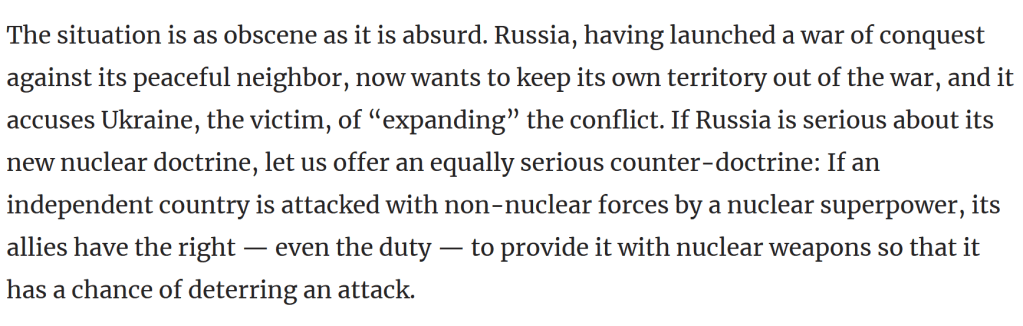
Note the use of “deter” in this paragraph. But what Zizek is discussing is not really deterrence in the way its usually thought of. Under this scenario, the opponent has already begun its attack. If the defender acquires nuclear weapons at a later point, it may try to deter further offensives, but the defender will almost certainly also try to threaten – or even use – its nuclear weapons to force the aggressor to give back lost territory, which is compellence, not deterrence. So which concept is Zizek discussing? Once a conflict has actually begun, the line between the two becomes a little muddy.
I’d argue that Ukraine doesn’t even need to consciously use its new nukes as a compellence weapon; they would be de facto compellence weapons, because even if they were not used, and even if Ukraine publicly declared it would not use them to compel, any Ukrainian conventional attack would carry the threat that a Russian counterattack may trigger a Ukrainian nuclear response, especially if the war starts to go so poorly for Ukraine it begins to be imminently existential. Russia would see them as compellence weapons, even if that was not the idea. So a nuclear Ukraine would not be a story simply of deterrence – the world would run the extreme risks associated with a Ukraine that may be perfectly willing to attempt to regain lost ground by advancing with conventional forces backed up by nuclear forces.
I should point out that nuclear compellence has a pretty bad track record. Of all the times in which there was a confrontation between nuclear powers with one trying to compel the other that included serious threats of nuclear war, there are only two I’d consider to be fully successful: the Cuban Missile Crisis of 1962, with the compeller being the United States, and the Sino-Soviet Crisis of 1969, with the compeller being the Soviet Union. If you’d like to know more, Todd S. Sechser and Matthew Fuhrmann have written a great book on the subject. But we’ve never had a compellence situation in which two states are in a major conventional war and one proliferates. Its unknown territory, and all these cases are highly circumstantial.
There is, however, good reason to think it wouldn’t work. Under a traditional framework for escalation, like for example, Herman Kahn’s, states escalate because they believe they can gain advantage by moving the conflict to a higher rung of the escalation ladder. For example, a state with a weak conventional force may adopt a first strike nuclear posture and threaten to escalate to nuclear weapons at very low levels of conflict in order to prevent conventional defeat. This is the theory that North Korea appears to have adopted, for example. On the other hand, a state may deter an adversary from escalating a conflict by ensuring it has a relative advantage in forces at whatever level the conflict is currently in – this has been the thinking guiding United States military planning for many years. As the United States has a much more capable military at almost all levels of conflict over almost all adversaries, it can deter escalation from anyone at any time (in theory).
The problem for Ukraine is that even if it were to acquire nuclear weapons, it would not have relative advantage whatsoever vis-à-vis Russia. Regardless of what targets it threatens to strike with its nuclear arsenal, Russia is always going to have more nukes to respond with. Some examples. Let’s imagine, simply for the sake of argument, that Ukraine manages to put together about a dozen rudimentary single stage weapons without anyone catching on and places them atop short range missile systems. What targets present themselves to Ukraine? They could fire nuclear weapons at Russian army concentrations at the frontline. Given the incredibly distributed nature of this conflict, such an attack would only net Ukraine very limited gains. The nukes they’d fire would be pretty small, and even though they’d evaporate anything they targeted, they’d only manage to put a minor dent into the Russian force as the force is distributed across a front that spans hundreds of miles. Russia would then obviously respond with its own tactical nuclear weapons, which it has many, many more of. Such attacks would then inflict much more damage to Ukrainian forces than Ukraine could deal to Russian forces.
Alternatively, Ukraine could threaten Russian cities. If they acquired a ballistic missile with a suitably long range to target St. Petersburg and Moscow (another difficult ask for them) they could inflict hundreds of thousands of casualties on Russian civilians. There are, obviously, problems here too, one being that such an action would not exactly endear them to the nations currently supplying Ukraine with most of its weapons, as those countries believe in silly little things like “The Geneva Convention” and whatnot.
But the other problem is that Ukraine would have no defense against Russia doing the exact same thing to Ukraine with ten times the effect. Russian nuclear weapons are larger, more sophisticated, and can by used on missiles Ukraine cannot intercept. A Ukrainian strike on Moscow would certainly be met with a catastrophic response by the Russians that would end any hope of Ukraine winning the conflict. So why would Putin be deterred, when he knows he holds the cards? Ukraine even managing to strike Moscow is debatable, partly due to the range involved, and partly as Moscow is protected with a pretty robust air defense network of nuclear tipped interceptors.
Putin has already proven willing to accept catastrophic losses in both life and economic power over the Ukraine issue. Putin also does not believe that the Ukraine War is an isolated affair, or a border skirmish that can be easily extracted from: he believes that the Ukraine War is central to Russian security and a piece of a much broader conflict between Russia and the Collective West. Arguments that Putin would be at all deterred by a Ukraine with a modest nuclear arsenal are not convincing, and advocates have so far been unable to solve the entanglement problem with NATO. Ukrainian nuclear use or threats would be tied together in Russian thinking with NATO threats, as Russia would not be at all certain that NATO would not take advantage of a Russia struggling in even a small scale nuclear conflict with Ukraine (the mirror of US’s concerns about North Korean action leading to Chinese action against Taiwan). Any proliferation of Ukraine would therefore carry grave risks for NATO.
There is no benefit to a nuclear Ukraine. It would be catastrophic for nuclear nonproliferation, catastrophic for global stability, and catastrophic for the many civilians who would die in any nuclear confrontation between the two. The extraordinary alliance of Kenneth Waltz and Slavoj Zizek and the followers of that train of thought can look back to the previous 70 years of evolution on nuclear deterrence thought to understand why the anti-proliferation crowd has been winning the argument for some time.


 hors d'oeuvres of Battle
Leave a comment